
Lumbago: one tiny movement, and you’re bent double
You leaned over the washbasin, and your lower back locked up on the spot. You can’t straighten up, and every step takes your breath away. What has just happened in your back, what helps from the very first hours, and how to stop it locking up again.
One movement was all it took. You leaned over the washbasin to rinse your face, and something gave way in the small of your back. A stabbing pain, then nothing moves any more. And there you stay, clinging to the edge, bent double, trying to work out how to straighten up without crying out.
You may know the minutes that follow. Crossing the flat holding on to the walls. Giving up on tying your shoelaces. Managing to sit down, then realising that you will now have to get back up. And that question going round and round: what have I done to myself?
Let’s start with what is reassuring. As French national health insurance points out, there is no link between how intense the pain is and how serious it is. Lumbago can hurt a great deal without your back being damaged.
Let’s look at what has just happened, what helps during the first days, then the story of a patient who arrived at the clinic with his back locked, and what his belly had to do with his back. And finally, how to avoid the next bout.
A word of caution first. A leg that loses strength, reduced feeling in the skin between your thighs, difficulty passing urine: in these cases, call 15 (French emergency medical services) straight away. You will find all the warning signs a little further down.
Your back isn’t broken, it has locked up
What you are going through has several names: lumbago, putting your back out, and, for doctors, acute low back pain. The mechanism, though, is almost always similar. Your body judged a strain to be threatening, and it shut the door. The deep muscles of the lower back contracted all at once to prevent any movement. It is this protective contraction that keeps you bent forward and stops you from straightening up.
This lock is frightening, because it comes down without warning. Yet as a rule, nothing has moved out of place, nothing has torn. The back is protecting itself, and it overdoes it.
There remains a question people rarely ask: why that movement, that morning? You have leaned over that washbasin thousands of times. Think back to the weeks before. Days spent sitting without moving, perhaps. Nights that were too short, a busy period, a stomach that wasn’t digesting well.
That movement made the glass overflow.
It had not filled it.
If the pain goes down into the buttock and the back of the thigh, below the knee, with electric shocks, the sciatic nerve may be involved. Our article Sciatica: it keeps coming back, and you don’t know why will help you see more clearly.
How long does lumbago last?
The worst usually lasts a few days. After that, the back gradually unlocks. In the vast majority of cases, lumbago gets better within a few weeks.
Most cases of lumbago pass on their own in this way, and you may not need us. If you would rather have support right away, or if this is not your first one, we see locked backs Monday to Sunday: book an appointment.
Without any warning sign, the French National Authority for Health (HAS) recommends neither an X-ray nor an MRI during the flare-up. An image would mostly show the ordinary wear and tear of an adult back, which is also found in people who have never had any pain. To find out more, read What really happens in a painful back.
What to do in the first few hours
First, the signs that can’t wait
Lumbago can almost always be treated at home, except in the following situations.
Call 15 or go to the emergency department if a leg loses strength, if the skin becomes less sensitive between your thighs, around the genitals or the anus, if passing urine becomes difficult, if you have leaks, or if you can no longer control your bowels.
Call your doctor without delay if the pain does not ease in any position, is still there at rest and at night, or gets worse day by day. The same applies if you have a fever, a burning sensation when passing urine, unusual tiredness, weight loss that nothing explains, pain that spreads up into the upper back, or if the pain started after a fall or a violent blow.
A history of cancer, long-term cortisone treatment, or a first episode before the age of twenty or after fifty-five: tell your doctor about it from the start.
Chest pain, breathlessness or feeling faint: call 15.
Then, a rule that goes against instinct: move. Not much, not fast, but move. Bed rest is not recommended, French national health insurance reminds us, and the HAS makes physical activity the main treatment for back pain. Take a few steps around the flat every hour, even bent over, even slowly. Walk a little further each day: if the pain wakes up when you move, it is generally not a danger, it is the sign of a back getting going again.
Bed brings relief for an hour.
Movement brings relief for the week.
As for medication, your pharmacist or your doctor will tell you which one to take. A painkiller does not shorten lumbago, but it can make movement possible, and it is movement that helps the back heal. Ibuprofen and other anti-inflammatories should not be taken for more than five days without a doctor’s advice. If you are pregnant, never take them without a doctor’s advice: from the sixth month onwards, they are contraindicated, even once, even as a gel or cream.
Avoid forcing to get your movement back, and leave your back alone: no cracking it yourself. A back in spasm has to be coaxed. It cannot be forced.
Living with a locked back, movement by movement
To get out of bed. Don’t sit up in one go with your back bent. Start by rolling onto your side, knees bent, let your legs slide off the bed, then push yourself up with your hands. Your back follows, as one block.

To get dressed. Sit down to put on your trousers and socks, and bring your foot up towards you rather than reaching down to it. While the flare-up lasts, a long-handled shoehorn will save you from bending down to your shoes.
To wash. At the washbasin, bend your knees slightly and lean one hand on the edge: your hand carries your upper body, not your back.
To sit down and get up. Choose a high, firm chair rather than a sofa you sink into. To get up, move forward to the edge of the seat, feet well under you, and push on your thighs.
Your questions about lumbago
Heat or cold? Heat. A bath, a hot shower on your lower back or a hot-water bottle slipped into a towel help to relax muscles stiffened by the flare-up. Keep a layer of fabric between the hot-water bottle and your skin, and don’t fall asleep on it.
What position should you sleep in? On your side, knees slightly bent, with a cushion between your knees. Avoid sleeping on your front, the most uncomfortable position for a painful back. On your back, a pillow under your knees can also bring relief.
Do you need to stop working? Not always. As French national health insurance points out, sick leave is not usually necessary, and getting back to your activities, adapting them, helps the back heal. If your doctor signs you off, they will review it after a few days. At the office, get up at least every two hours to walk or stretch.
Can you carry heavy things? Not during the flare-up. After that, build back up gradually: squat down using your legs, hold the load close to your body, and don’t twist your upper body when you are bent forward. Avoid carrying more than ten kilos.
When can you get back to sport? As soon as you feel up to it, gently. Walking first, then swimming or gentle exercise, which strengthen the back and the abdominal muscles. Warm up, and increase the effort at your back’s pace. According to the HAS, regular physical activity helps the back heal and limits recurrences.
Can I come to you while my back is still locked? Yes, even bent double, from the very first day, if none of the warning signs in the box apply to you. We go through them with you before we start, and no referral is needed: book an appointment. Can’t find a slot that suits you online? Send us a message on WhatsApp at +33 6 51 77 41 86: tell us in a sentence what is happening and when you are available, and we will look for a solution.
How long a session lasts, how many sessions you need, reimbursement: the answers are in our FAQ.
When the back pain came from the belly
I am thinking of a patient in his fifties who came to the clinic with his back locked. He was walking slightly bent forward, and the pain was excruciating. Impossible to bend down to put on his shoes or his socks. Impossible, too, to straighten up and stand upright.
His back was crying out. Yet when I carried out the ASSAL test, the area weighing most on his body that day was not in his back. It was in his belly.
A locked back is not always a back problem.
The belly and the lower back depend on the same levels of the spinal cord. When an organ in the belly is not working properly, without actually being diseased, it can keep up a tension in the back, at a distance, without necessarily making itself felt. If your back pain comes with abdominal pain, vomiting or blood in your urine, see your doctor first.
So I started with his belly, using gentle techniques. Then I finished with a global hip technique, to give mobility back to his hips and legs. It can be done even in the middle of a flare-up: the patient pushes, lets go, and feels things moving. All the work comes from him.
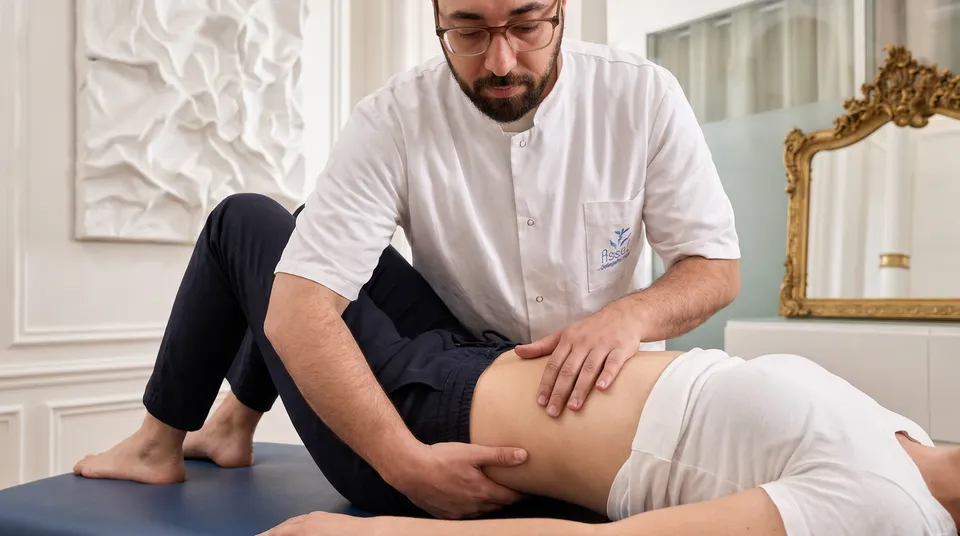
He left the same day able to bend down, and to straighten up, his back straight. I asked him to come back some time later, to consolidate the work.
It is not always this quick, and we never promise it: every body has its own pace. But his story sums up the ASSAL Method: looking for the cause where it is, even far from the place that hurts.
If your back has locked up and you want to know where it comes from, that is exactly what we look for in our clinics in Paris 8 and Vitry-sur-Seine: book an appointment.
Avoiding the next bout of lumbago
Once, it happens. When your back locks up again, and then again, it is another story: you end up wary of every movement.
A first bout of lumbago can pass for an accident.
The third in two years owes nothing to chance.
At the clinic, one question comes up often: “Is this the first time, or is it a pain you already know?” A back that locks up regularly is compensating for something: a pelvis that moves badly on one side, a diaphragm frozen by months of tension, or a belly that isn’t working properly. Stress alone increases the tone of the back muscles and the diaphragm.
The first remedy is still movement, every day. Regular physical activity, adapted to your abilities and preceded by a warm-up, protects your back, as French national health insurance points out. Break up long hours of sitting. And for simple exercises, at home or at the office, French national health insurance offers a free app, Activ’Dos. A session does not replace this movement: between sessions, you do most of the work.
The rest is what your back is compensating for. Coming between two episodes, when all is well, makes sense: that is the time to look for what is wearing it out, before it locks up again. For us, a patient who doesn’t come back for the same locked back is a job well done.
Lumbago can leave a mark that lasts longer than the pain: the fear of bending forward. Understanding what happened helps you leave it behind.
One morning, you will lean over the washbasin again without thinking about it. That is the morning we are working towards, with you.
“Exemplary professionalism! When I came in, I couldn’t walk straight because of lumbago, and when I left, everything was better.”
Katia, patient at the Vitry-sur-Seine clinic (translated from French)
We will take the time to look for where this locked back comes from, and to show you what we find. Book online, Monday to Sunday:
In Paris 8, with me or with Michaël.
In Vitry-sur-Seine, with me or with Amine.
Prefer to call? +33 1 44 09 95 80 for Paris 8, +33 1 75 37 53 41 for Vitry-sur-Seine.
Your back locked up for a reason.
Let’s find it together.
Find the origin of your pain
A consultation helps you understand where your pain really comes from, and how to address it, taking your history into account.