
Sciatica: it keeps coming back, and you don’t know why
The shooting pain in the buttock, the leg burning all the way down to the foot. Nights spent searching, in vain, for the position that brings relief. Then the flare-up passes, you forget, and one morning it all starts again. What is going on in your body, and what can bring you relief, starting tonight. And why the answer is rarely found in the leg.
It is three in the morning. You have left the bed for the sofa, then the sofa for the living-room rug. On your back, it pulls. On your side, a jolt wakes you as soon as you doze off. So you stay standing in the kitchen, one hand on the worktop, waiting for the medication to work. Perhaps you are even reading these lines right now, your phone in your other hand.
The day was no easier. Putting on your socks took a strategy. A sneeze pinned you to the spot. Getting out of the car, getting up from a chair: every movement has to be negotiated with this pain that starts in the buttock and runs down to the calf, sometimes to the foot, like an electric current.
And then there is what others don’t see. The tiredness of broken nights. The dinner where you stay standing “to stretch your legs”, because you can no longer stay seated. The fear, too, the day the words “herniated disc” appear on a scan report.
And perhaps you already know this night. It had gone. It came back.
First, let’s look at what is happening in your body, and what can bring you relief, starting tonight. Then why it comes back, and what a session looks like when we finally search for where it comes from.
Just one precaution before anything else: if your leg or foot loses strength, or if you have difficulty passing urine, don’t wait, call 15 (French emergency medical services). The other warning signs are described further down.
Your leg has nothing to do with it
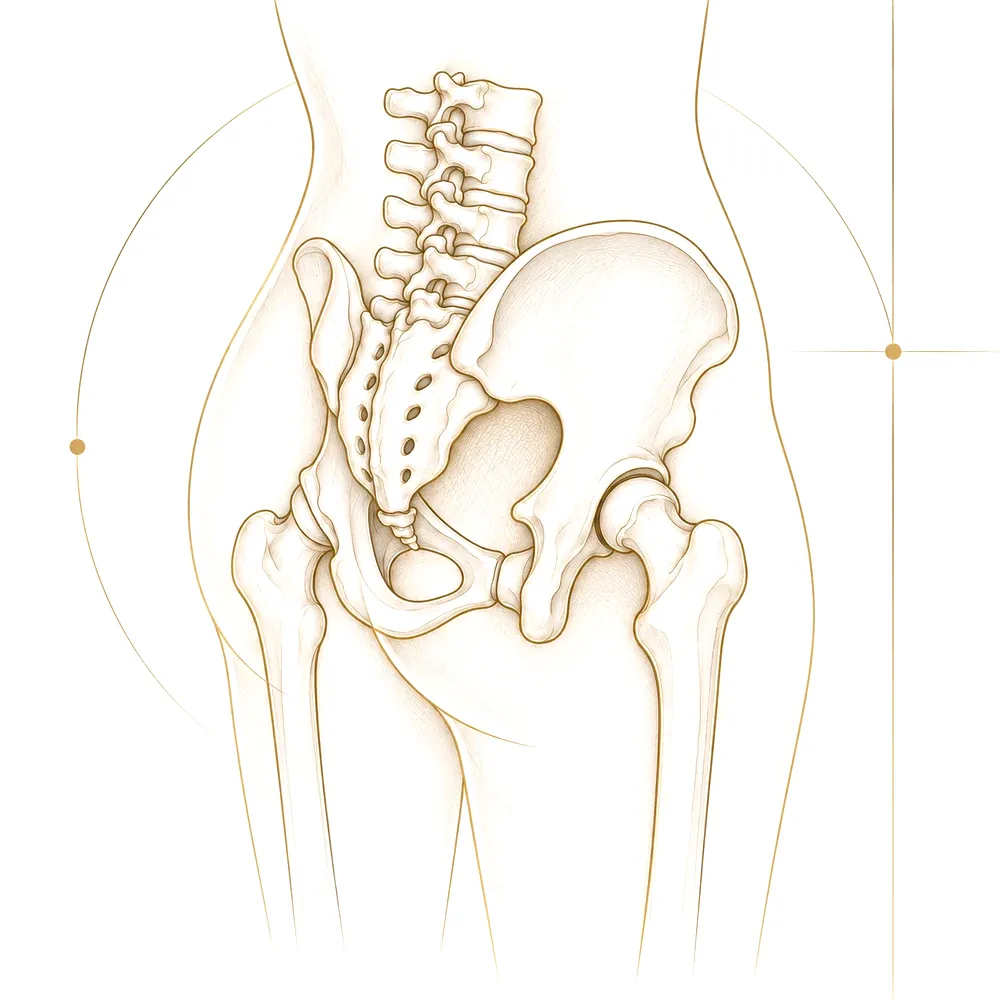
The sciatic nerve starts in the lower back, then runs down through the buttock and the back of the thigh to the foot. When it is compressed or irritated along this path, the pain follows its whole route. Most often, this happens where it leaves the spine, because of a disc that bulges out: this is called a herniated disc. But it can also be irritated lower down, in the buttock, by a deep muscle that is too tight. In every case, your leg hurts, and yet your leg has nothing to do with it. It acts as a loudspeaker for a nerve irritated higher up. So massaging the calf brings very little relief.
The pain is in the leg.
The story begins elsewhere.
At the clinic, one of our first questions is simple: “Do you have electric shocks in your buttock, thigh or leg?” Sciatica usually goes down below the knee, with pins and needles, a feeling like an electric current. Pain that stays in the buttock or thigh, without going below the knee, often comes from a joint that has lost its mobility, between the sacrum and the pelvis or at the bottom of the spine. It looks like sciatica without being sciatica: this is sometimes called pseudo-sciatica. Not all pain that runs down the leg comes from a herniated disc.
A word about herniated discs, since the term is frightening. A herniated disc seen on a scan does not always cause pain. Many people have one without knowing it and without any pain: the article What really happens in a painful back explains this in detail. At first, no test is useful. An MRI is something to discuss with your doctor if the pain persists or becomes complicated. Surgery has its place, sometimes urgently, sometimes when the pain lasts despite treatment. Your doctor will tell you whether it applies to you. Most cases of sciatica never need it.
And it is hard to believe when you are in pain, but in the vast majority of cases, sciatica gets better on its own, in about two months. That is a long time, and I would rather be upfront about it. The first days are the hardest, then the pain recedes in stages.
Why does it so often pass on its own? Around a herniated disc, the nerve is not only compressed. It is also inflamed by substances released by the disc. Over the weeks, this inflammation dies down, and the body often does its own clean-up: its defence cells gradually absorb the part of the disc that bulges out. It is to calm this inflammation that your doctor may prescribe an anti-inflammatory for a few days. What put this nerve under strain, on the other hand, does not always go away with the flare-up.
For the lower back in general, the page Lower back, pelvis and lower abdomen goes further.
What to do tonight to get through the flare-up
First, these signs that can’t wait
Ordinary sciatica does not need urgent care. A few situations are exceptions.
Go to the emergency department or call 15 if your leg or foot loses strength (this is known as paralysing sciatica): your foot catches when you walk, you can no longer stand on your toes or on your heels.
The same applies if the pain goes down both legs, if you have reduced feeling in the skin between your thighs, around the genitals or the anus, if you have difficulty passing urine or leaks, if you can no longer control your bowels or if you are unusually constipated.
Call your doctor without delay, or 15 if you cannot reach them, if the pain is so severe that your usual painkillers do not relieve it, or if you have a fever.
Also make an appointment with your doctor if the pain does not improve after a few days, if it gets worse at night, if part of your leg gradually becomes numb, or if you have lost weight for no reason.
Keep moving, at your own pace: French national health insurance advises against prolonged bed rest. Walk a little, several times a day. As soon as the pain allows, swimming is possible too.
To rest, lie on your back with your calves on the seat of a sofa, hips and knees bent. In bed, firm pillows under your knees have the same effect. On your side, slip a firm cushion between your knees. The pain eases, sometimes within a few minutes.

Heat also helps the muscles relax: a hot bath, or a hot-water bottle wrapped in a cloth on your lower back or buttock. Don’t fall asleep on it, and be careful not to burn yourself, especially if your skin feels less sensitive. A painkiller can help you move: ask your pharmacist or your doctor for advice. Without a doctor’s advice, an anti-inflammatory such as ibuprofen should not be taken for more than five days. During pregnancy, never without a doctor’s advice, and from the sixth month onwards it is contraindicated, even as a single dose, including as a gel or cream.
On the other hand, don’t pull on the back of your thigh to “loosen the nerve”: an irritated nerve does not like being stretched. And don’t crack your own back. Cracking is not treating.
The days that follow: movements that help
To get out of bed. First turn onto your side, knees bent. Then let your legs come down off the bed while you push on your arms to sit up. Your back moves as one block.
To sit down. Choose a firm chair rather than a low sofa, with your feet flat and a small cushion in the small of your back. Avoid sitting for long: if you work at a screen, get up every half hour to walk a little.
In the car. Avoid long journeys during the flare-up. If you have to drive, move your seat forward so that your leg is not stretched, and stop to walk for a few minutes.
When you cough or sneeze. This is often when the jolt strikes. Bend your knees slightly, keep your back straight, or steady yourself with one hand against a wall.
To carry things. Bend your knees, keep the load close to you, and avoid lifting anything heavy while the flare-up lasts.
At work. If the pain is bearable, French national health insurance advises carrying on with your activities while adapting them, without forcing. For office work, one or two days of sick leave are usually enough.
A little more each day. Moving may stir up the pain without being dangerous, and it helps you recover. Walk a little longer each day, at your own pace.
When the pain builds. Place a hand on your belly and breathe slowly, letting it rise. The diaphragm, the large breathing muscle, is connected to the lower back: when it relaxes, the whole body lets go a little.
Write down what you go through. What relieves it, what makes it worse, the time of day when the pain is at its worst. Bring these notes to your appointment, with your test reports if you have any: they help us follow the thread back.
If the pain does not recede, or if you want to understand why it is there, we can see you from the very first days: book an appointment.
Then, one morning, it comes back
The first time, you did what everyone does. You gritted your teeth, followed the advice of your doctor or your pharmacist, and waited. The pain went away. A few weeks later, you no longer thought about it.
And one day, as you bent down to pick up a pen from under the desk, the jolt came back. Same leg, same path. And that little voice in your head: “Not again.”
You do everything that worked before all over again. It works a little less well. People around you talk about age, stress, a fragile back. You are advised to live with it. You end up wondering what you are doing wrong.
So let me tell you straight away: it is not your fault.
Sciatica that keeps coming back is a question still waiting for its answer.
Why your sciatica keeps coming back
When sciatica comes back, the flare-up is calmed again, and that is essential. But one question remains unanswered: why did this particular nerve end up under strain, and why this one again?
In osteopathy, we look at your body as a chain. When one area loses its mobility, sometimes for years, the others organise themselves to compensate, silently. The pelvis twists a little, breathing moves up into the chest. The lower back starts working for two. One day, with an everyday movement, the area that was compensating the most ends up protesting. The nerve is only footing the bill.
As long as the imbalance stays in place, the body rebuilds the same strains, and the flare-up can come back, often at the same time of year or after the same kind of effort.
What gets stuck higher up can show itself lower down.
At the clinic, in patients with sciatica, we regularly find a tension coming from much higher up, as far as the base of the skull. When we go back over their history, a memory sometimes resurfaces. An old fall onto the buttocks. A car accident, a whiplash injury several years old. An emotional shock. None of it hurt any more. The patient had forgotten it, and their body had adapted.
Why does the pain come back? Our whole way of working was born from this question. Our vision: that no recurring pain should remain unexplained. Our aim, at every session: to find the cause of a problem, not just to relieve its symptom. Many patients come to the clinic with pain that keeps coming back, without knowing why. It is from this reality that the ASSAL Method was born, over the years and patient after patient: a thread, a logic for tracing back, in each patient, to the origin of their functional problems, often far from where it hurts. All three of us apply it, in Paris 8 and in Vitry-sur-Seine.
If you are still trying to find out why your sciatica keeps coming back, same leg, same path, this method is meant precisely for you.
The day you finally understand
Imagine. You push open the clinic door, your leg still heavy from the night.
We start by listening to you: the first flare-up, and everything you have already tried. Then we ask you questions that surprise you, about an old fall or a difficult period. Sometimes a memory resurfaces that you had never connected with your back.
Next, you lie down, and we carry out the ASSAL test, on which the method is based, a short and precise examination. It does not look for the place that hurts. It points us to the area which, on that day, weighs most on your body’s balance, sometimes far from your leg, sometimes without any pain at all.
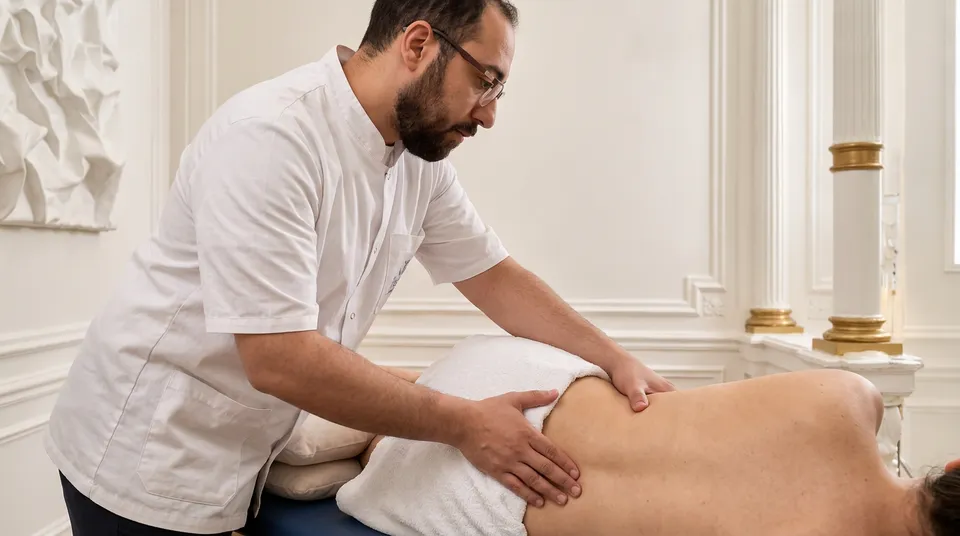
We treat it, then we repeat the test in front of you. This time, you see it for yourself, as it happens. Sometimes another area appears underneath, which the first one was masking. We treat that one in turn. Layer after layer, the order in which your body adapted becomes clear.
Before you leave, we explain what we found: how your body may have got to this point, and what can bring the flare-up back.
I am thinking of a young teacher who came in with neck and knee pain that kept coming back a few weeks after each treatment. At the end of the session, she already felt much better, and she was surprised: “But why has no one ever done this for me before?” I told her that all osteopaths receive the same training, but that each one remains unique. Like cooks: the same ingredients, never the same dish.
We offer this session in Paris 8 and in Vitry-sur-Seine, Monday to Sunday: book an appointment.
What we will never do
We will never promise you a miracle. Your body took time to build up its compensations. Every body keeps its own pace in letting them go.
In the middle of a flare-up, we never force anything. We start with gentle techniques, well tolerated from the very first days. More direct manipulations wait for the next session, when your body is ready, and never without warning you.
We won’t hold on to you if your pain calls for something else. If it is too intense for us to be able to work, we refer you to your doctor to calm the flare-up, and we see you again afterwards. Knowing when to stop is part of the job. The herniated disc itself is a matter for your doctor. We work on the areas of your body that have lost their mobility and force the lower back to compensate.
What we promise you is to look for what, in your body, prepared the ground, and to repeat the test in front of you.
Understand first.
Then treat.
Before you come
Can you come in the middle of a flare-up? Yes, from the very first days, if you have none of the warning signs described above. We also check them before we start. No referral needed.
How long does a session last? Between forty-five minutes and an hour.
How many sessions will you need? It depends on your history. In the middle of a flare-up, your body needs two to three days to integrate the session, and a stabilising session may be useful one week to ten days later. We tell you at the end of the first session.
Is it reimbursed? French national health insurance does not reimburse osteopathy. Your top-up health insurance (mutuelle) may cover part of it, and we give you an invoice.
What if my sciatica has lasted for weeks? Talk to your doctor about it as well. Your doctor is the one who will say whether a test is useful.
What now?
If your sciatica has just started, there is a good chance it will pass. Move at your own pace, and keep the warning signs in mind.

If it comes back, if you already know the jolt and the sleepless nights by heart, your body has been asking you a question for a while. It deserves an answer. Don’t wait for the next flare-up to look for it: you can also come between flare-ups, when the pain has calmed down. It is better to understand before you are in pain again.
Putting on your socks without thinking about it. Sleeping through the night. These are small things, until the day you lose them.
“He has been treating me for years and he is the only one I trust, even during my pregnancy. Thank goodness he is there to relieve my back pain, sciatica, stomach pain and so on. He also treats my whole family. No regrets about travelling more than 100 km for each visit.”
Henia, patient of Hosam ASSAL in Vitry-sur-Seine (translated from French)
We will take the time to go over your story from the beginning, and to look with you for where it started. Book online, Monday to Sunday:
In Paris 8, with me or with Michaël.
In Vitry-sur-Seine, with me or with Amine.
Prefer to call? +33 1 44 09 95 80 for Paris 8, +33 1 75 37 53 41 for Vitry-sur-Seine.
Your sciatica has a story.
It also has a starting point.
Find the origin of your pain
A consultation helps you understand where your pain really comes from, and how to address it, taking your history into account.