
What really happens in a painful back
You were told you had a herniated disc, or you were told nothing at all because your tests were normal. Either way, the pain is still there. Here is what is really going on in a painful back, and why it keeps hurting long after the initial cause has gone.
The paradox nobody explains to you
Two situations come up again and again in our clinics, and on the surface they contradict each other.
The first: you have been in pain for months, you have had an X-ray, a CT scan, sometimes an MRI, and everything is normal. You were told there was nothing wrong. You left with your pain and the uncomfortable feeling that you were suspected of exaggerating it.
The second: your scans show a herniated disc, degenerative disc disease or osteoarthritis. You were shown the image, the problem was explained to you, and ever since you have felt that your back is damaged for good.
A scan takes a picture of your anatomy. It does not take a picture of your pain.
Both situations have the same explanation. An image shows the state of your structures at a given moment. It shows neither how your body uses them nor what changed on the day your pain began.
What imaging sees, and what it leaves out
Abnormalities visible on a lumbar MRI, such as narrowed discs, disc protrusions or osteoarthritis in the joints, are extremely common in people who have never had back pain in their lives. Radiologists even have a word for these findings that have nothing to do with the reason for the scan. They call them incidentalomas.
This is why French and international guidelines advise against ordering back imaging in the first few weeks, unless specific warning signs are present. It is not a question of saving money. The reason is that an image shown too early can do more harm than good.
One study looked at patients who read their imaging report on their own. Reading it can trigger anxiety, especially in people who tend to imagine the worst. And anxiety is one of the factors that do most to prolong back pain.
So the useful question is not whether your MRI shows something. It is whether that something explains the pain you have today, and not the pain you did not have three years ago, when the image was probably already the same.
Stage one: the back locks up
Let’s go back to what actually happens on the day your back starts to hurt.
Something has happened. A movement, an exertion, a position held for too long, sometimes nothing you can pinpoint. Your body has detected strain on an area it considers to be under threat. Its response is immediate and automatic: it tightens the muscles around it, it limits movement, it locks up.
A back that hurts is, first and foremost, a back that is protecting itself.
This reaction is intelligent and useful. It blocks the movement that would make matters worse, until things calm down. The problem is not the locking itself. It is that it does not always release when it should.
After a few days, the initial strain has gone, but the protective contraction remains. It becomes a background state. You no longer feel it as a contraction but as stiffness, a back that “won’t uncurl any more”, an urge to crack it.
Stage two: the body shifts the strain
A locked area stops taking part in movement. Yet you carry on bending down, turning round, walking. Other areas take over the work it no longer does.
This is where it all plays out, and it is the stage that imaging never shows.
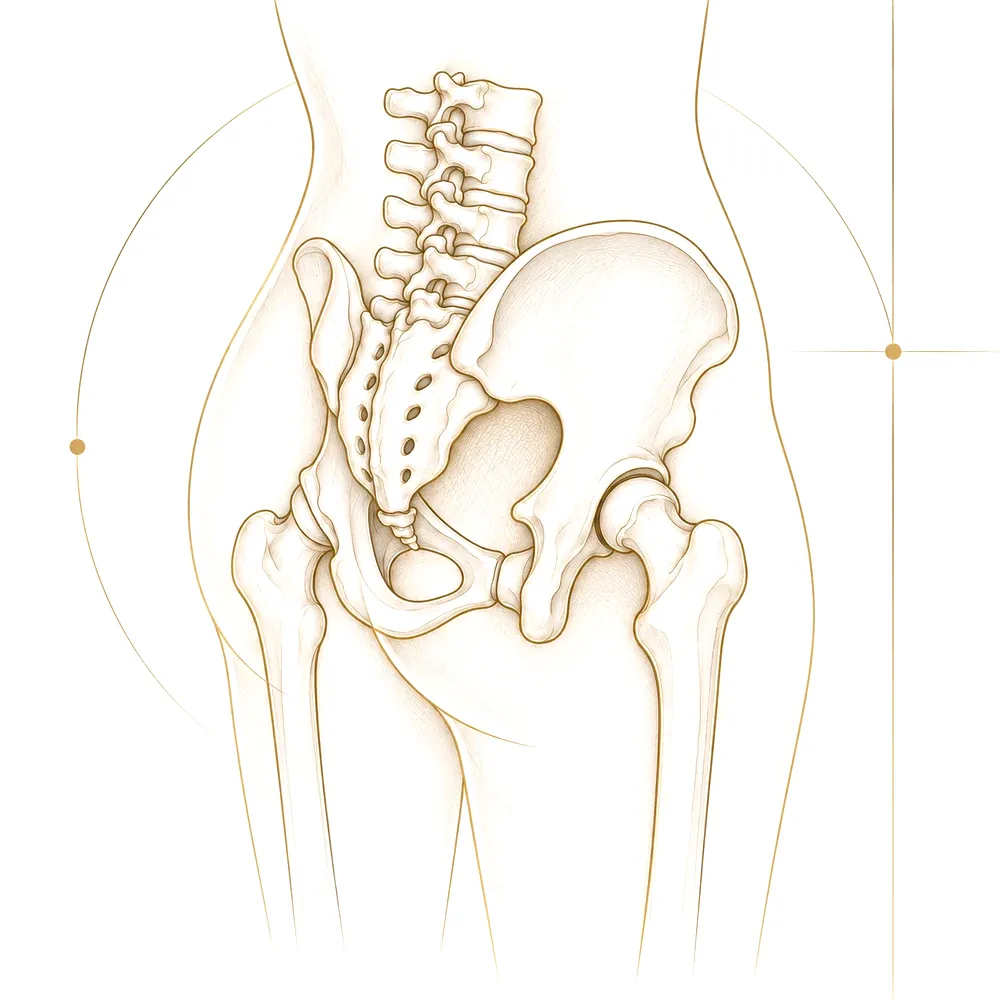
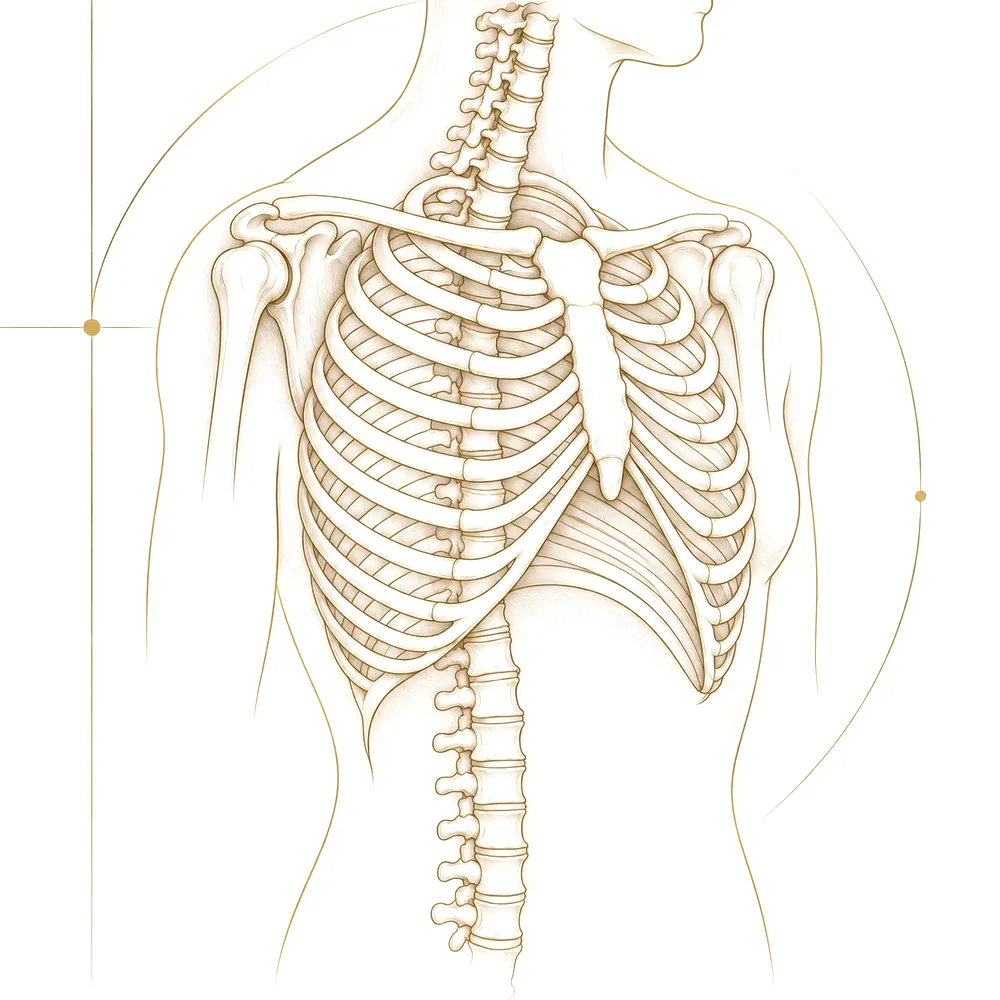
Your vertebrae, ribs, pelvis and hips form a transmission system. When one link stiffens, the neighbouring links compensate. They take on more movement, they work harder, they tire faster. This redistribution happens without you being aware of it, and it can hold up for months or years.
Then one day, the area that was compensating reaches its limit. It gives way in turn, and that is the area that becomes painful.
The result is confusing. The pain appears in a place that has never caused any trouble, while the starting point itself has long been forgotten. This is how an old ankle sprain that never properly healed ends up producing low back pain on the opposite side, or how a diaphragm held tight by stress keeps the lower back painful.
Stage three: avoidance, and the circle closes
You are in pain. So you do what anyone would do, and what you were probably advised to do: you avoid the movements that trigger the pain.
For a few days, that is common sense. Over a few weeks, it becomes a trap.
A muscle that stops working loses its strength. A joint you no longer move loses its range of movement. A back you protect all the time becomes a less capable back, and therefore more vulnerable, and therefore more painful at the slightest effort. You quite logically conclude that you need to protect it even more.
Rest eases today’s pain and sets up next month’s.
On top of this comes a belief that is very widespread, yet contradicted by the available evidence: the idea that moving wears out the back. Research on the subject shows the opposite. Regular activity improves the condition of the intervertebral discs. It is not movement that damages your back; it is a prolonged lack of it.
Stage four: the alarm system becomes oversensitive
When pain lasts beyond a few months, something changes in the way your nervous system processes it.
The circuits that carry pain signals become more reactive. The threshold shifts. Stimuli that used to cause nothing become unpleasant. The pain sometimes spreads to areas that were not affected at the start, or it comes on sooner, with less effort.
This mechanism is well documented, and it explains something important: at this stage, the intensity of your pain no longer measures the severity of an injury. It measures the sensitivity of your alarm system.
This absolutely does not mean the pain is imaginary. It is entirely real, and the mechanism that produces it is physiological. It means that working on the structure alone will no longer be enough, and that the body also needs to be given experiences of pain-free movement so that the alarm can recalibrate.
What stress adds to all this
There is one last piece of the puzzle, and it is the one patients find hardest to accept, because they often hear it as a polite way of saying it is all in their head.
When you are under pressure for a long time, your body goes into a state of alert. Your background muscle tone increases. Your breathing rises higher in the chest and becomes shorter, which reduces how far your diaphragm moves.
Now, the diaphragm does two things at the same time. It contributes to the stability of your trunk, working with the deep abdominal muscles and the pelvic floor. And its movement helps you return to a calm state, through the nerve that passes through its oesophageal opening.
So a rigid diaphragm means both weaker stability in the lower back and a state of alert that keeps itself going instead of switching off. The tension then travels down the chains of tissue that link the chest to the pelvis, and the lower back takes the strain.
What began as a one-off emotional reaction has become embedded in the body’s mechanics. Your pain is not in your head. It is in your body, and its starting point was somewhere else.
What this means for you
If you have read this far, you will now understand why entrenched back pain resists treatments that target only the painful spot.
Massage relieves the tight muscle without removing the stiffness that forces it to work twice as hard. Anti-inflammatories calm the reaction without changing how the strain is distributed. An injection numbs the area without changing what is putting it under strain.
All of these treatments have their place and their uses. They are not enough once the body has organised itself around the problem.
What needs to be found is the link that gave way first. It is rarely where you feel the pain, and it often makes no noise at all. Getting it moving again lets the areas that were compensating relax by themselves, because they no longer have any reason to compensate.
This is the principle behind the ASSAL Method, and it is also why we will ask you about your breathing, your digestion or a fall fifteen years ago when you have come in about your lower back.
Warning signs
Everything above concerns ordinary back pain, the kind that comes from a problem with how the back functions. Some situations fall outside this and need a doctor’s opinion without delay.
Loss of strength in a leg. Difficulty passing urine or holding it in. Loss of feeling in the area you sit on. Pain that came on suddenly after a violent impact. Pain accompanied by fever or weight loss. Pain that wakes you every night and that no position relieves.
If you have any of these signs, see your doctor or go to the emergency department before doing anything else.
In short
A back that has been hurting for a long time is rarely a damaged back. It is a back that has organised itself around an initial problem, often minor, often forgotten, and whose organisation has become more costly than the problem itself.
Understanding this changes the way you search. You stop treating the place that is crying out, and go looking for the one that has fallen silent.
Find the origin of your pain
A consultation helps you understand where your pain really comes from, and how to address it, taking your history into account.