Practitioner training
Training in the ASSAL Method
For final-year students and manual therapy practitioners: osteopaths, physiotherapists, chiropractors. Three days at the Paris 8 clinic, in a small group, to learn a clear framework that structures every consultation, from case history to retest.
Who the training is for
For those who keep circling the symptom
You leave school with a well-stocked toolbox, but no plan for using it.
This training is for practitioners who have learned many techniques without finding the logic that ties them together. For those who work without a framework, by trial and error, and who sense they keep circling the symptom without getting anywhere.
It is also for final-year students who are asking themselves: “I have learned a lot, but what do I do now? How do I structure a treatment?”
I have been there. My school gave me solid training, with a real range of techniques. But we were taught to follow a routine: active test, passive test, local treatment of the painful area. It worked, sometimes. But it stayed superficial. The ASSAL Method was born from that realisation.
The programme
A five-step framework
The method rests on five steps: the case history, the test, finding the priority, the treatment and the retest. In the morning, you learn its logic. In the afternoon, you put it into practice.
Step 1
The shared case history
It starts at the desk and continues on the treatment table. Knowing what to ask, spotting red flags, refocusing the patient when they go off on a tangent.
Step 2
The ASSAL test
A clinical test that steers the reasoning towards the starting point of the imbalance, before any treatment. It is described on the method page.
Step 3
Finding the priority
Reading the layers of adaptation and knowing where to start. It is the question that comes up in every consultation.
Step 4
Treatment, layer by layer
Treating in the order the body indicates. Every technique has its value: what matters is knowing when and why to use it.
Step 5
The retest
After each correction, you repeat the test. If the restriction persists, another layer is waiting to be released.
And when treatment reaches its limits? The training also teaches you to refer patients to the right professional. Knowing when to refer means respecting the patient’s body as much as your own scope of practice.
How it works
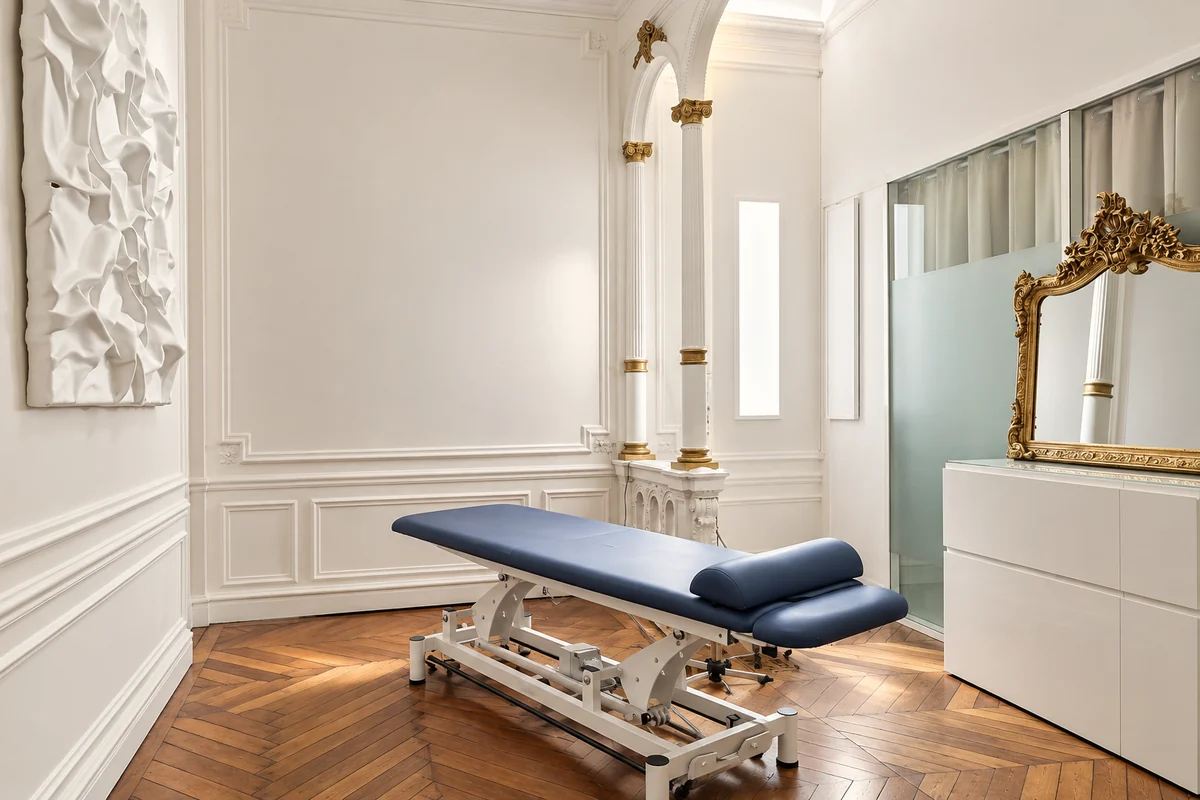
Three days at the Paris 8 clinic
In the morning, theory: the principles of the method and the reasoning that connects them. In the afternoon, practice. You observe, test, treat and retest, and I correct you as you go.
What I want to pass on to you is clinical reasoning: how things come together during the session, step by step, with no recipe and no fixed protocol.
The group has four to five participants, so that everyone has time to practise. At the end of the three days, you receive a training certificate.
For osteopathy schools
The training can also be held at your school, for an entire year group of sixty to a hundred and twenty students. Write to me to discuss it.
In practice
Practical details
- Duration
- Three days: theory in the morning, practice in the afternoon.
- Location
- Paris 8 clinic, 32 avenue de Friedland.
- Group size
- Four to five participants. At a school: an entire year group.
- Who it is for
- Final-year students, osteopaths, physiotherapists, chiropractors.
- Certificate
- Given at the end of the training.
- Price
- Quotation on request.
- Funding
- To run my courses, I work with Qualiopi-certified training organisations (Qualiopi is the French quality certification for training providers). Depending on your situation, the training may be funded by the FIF-PL (the training fund for self-employed professionals) if you are in private practice, or by the OPCO (your employer’s training fund) if you are an employee.
- Registration
- Places are limited: write to me for the next available dates.

Who leads the training
Hosam ASSAL, osteopath
“Look for the cause. Rely on the test. Treat with logic. Always check.”
A graduate of the École Supérieure d’Ostéopathie de Paris, I have practised in Paris 8 since 2013 and in Vitry-sur-Seine since 2017. The ASSAL Method grew out of my practice, over the years, patient after patient. Michaël in Paris 8 and Amine in Vitry-sur-Seine are trained in it and apply it every day.
Read my storyFrequently asked questions
Questions about the training
Do I need to be an osteopath to take the training?
No. It is for final-year students and manual therapy practitioners: osteopaths, physiotherapists, chiropractors.
How long does the training last?
Three days, at the Paris 8 clinic: theory in the morning, practice in the afternoon, in a group of four to five participants.
Is a certificate provided?
Yes, you receive a training certificate at the end of the three days.
Can the training be funded?
It depends on your situation. I work with Qualiopi-certified training organisations: if you are in private practice, you can submit the training to the FIF-PL; if you are an employee, to your employer’s OPCO.
When are the next sessions?
Sessions are held in small groups and places are limited. Email me at cabinet.assal@gmail.com and I will tell you the next available dates.
Can the training be held at a school?
Yes, for an entire year group of sixty to a hundred and twenty students. Write to me to discuss it.
Request a place
Places are limited to five participants per session. Write to me with your profession, or your year of study if you are a student, and I will reply with the next available dates and a quote.
Representing a company? See posture training for companies