
Tailbone (coccyx) pain: what to do when sitting hurts?
Every time you sit down, the pain comes back, sharp, at the very bottom of your back. After a fall, or for no obvious reason. Here is what relieves it, starting today, how long it lasts and which signs mean you should see someone. Then a lead: the answer is not always in the coccyx.

In short
Coccyx pain, which doctors call coccydynia, flares up mainly when you sit and when you get up; it often follows a fall, childbirth or long hours sitting, but it can also appear with no clear cause. To relieve it, sit leaning slightly forward on a cushion with a cut-out at the back and get up regularly: it usually improves within a few weeks to a few months. See your doctor if it does not improve after a few weeks, if it is constant even lying down or comes with a fever; call 15 (French emergency medical services) if a leg loses strength or you have problems passing urine.
At work, you can no longer stay seated for long. You shift onto one buttock, then the other, you try the edge of the chair. In meetings, you always find a reason to stay standing. In the evening, on the sofa, it is worse. And the moment you dread most comes when you have to get up: a sharp pain, like a nail driven in at the very bottom of your back.
Perhaps you fell on your bottom, skiing or on the stairs. Or you cannot remember any fall at all. That is exactly what worries you. Either way, this small piece at the end of your spine has taken over.
Why does my coccyx hurt when I sit down?
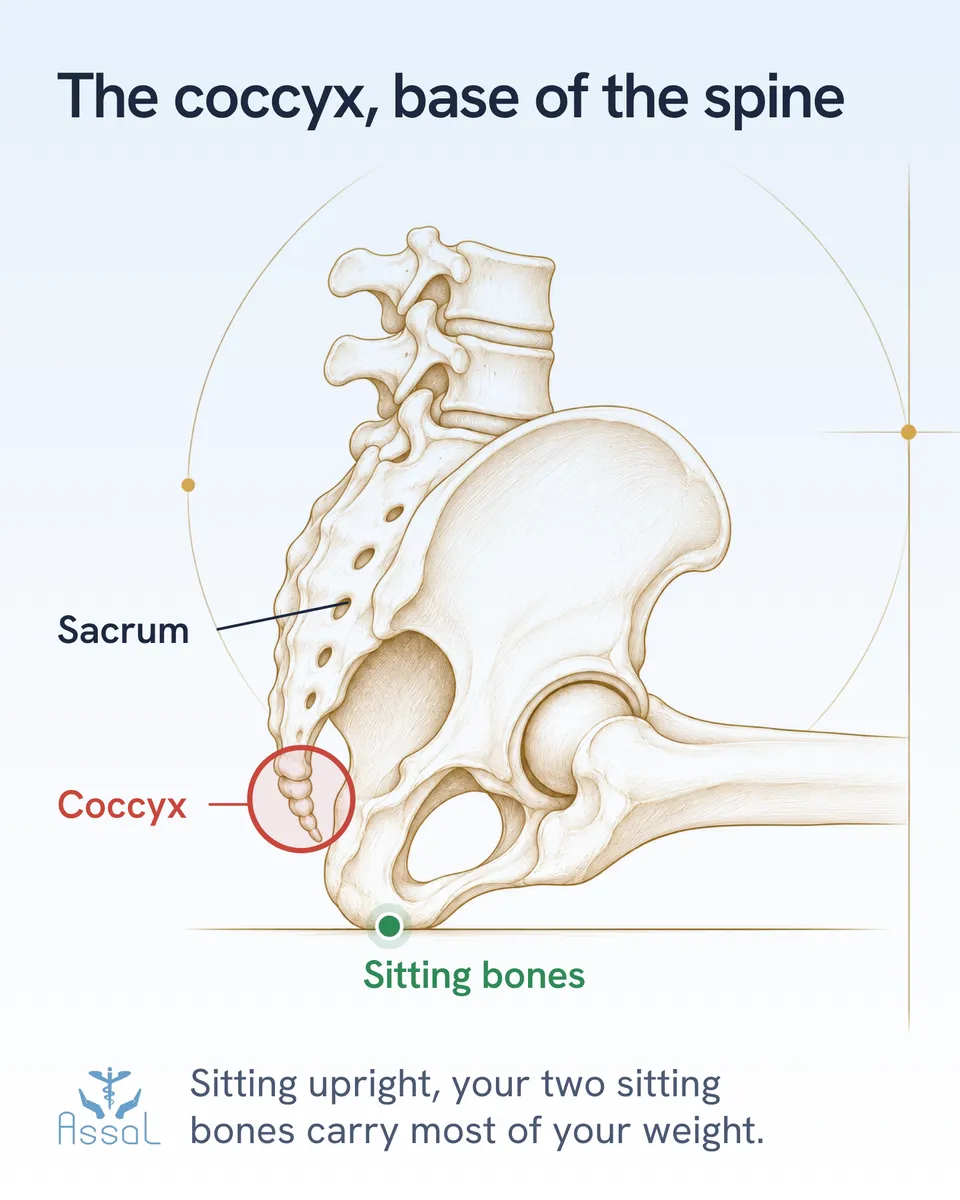
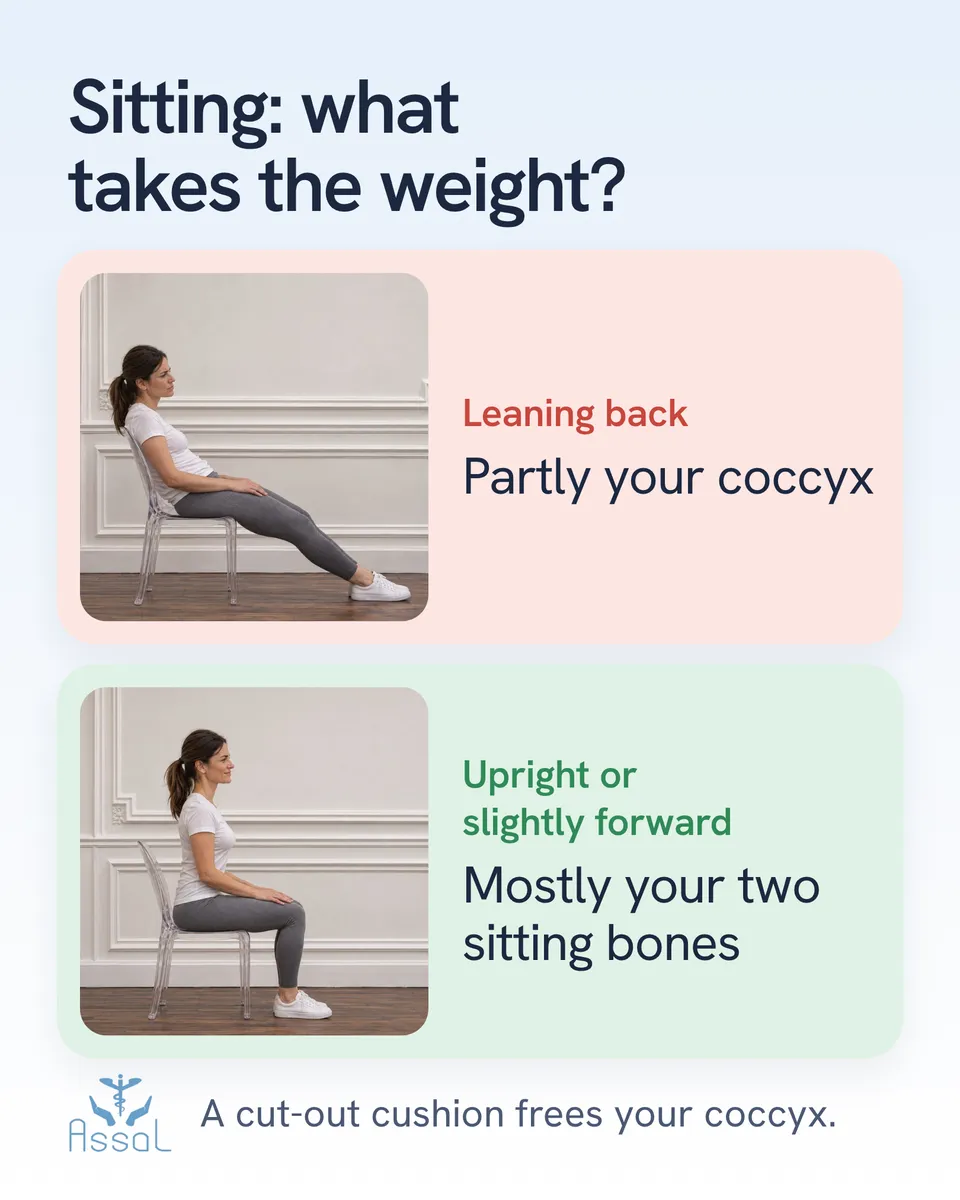
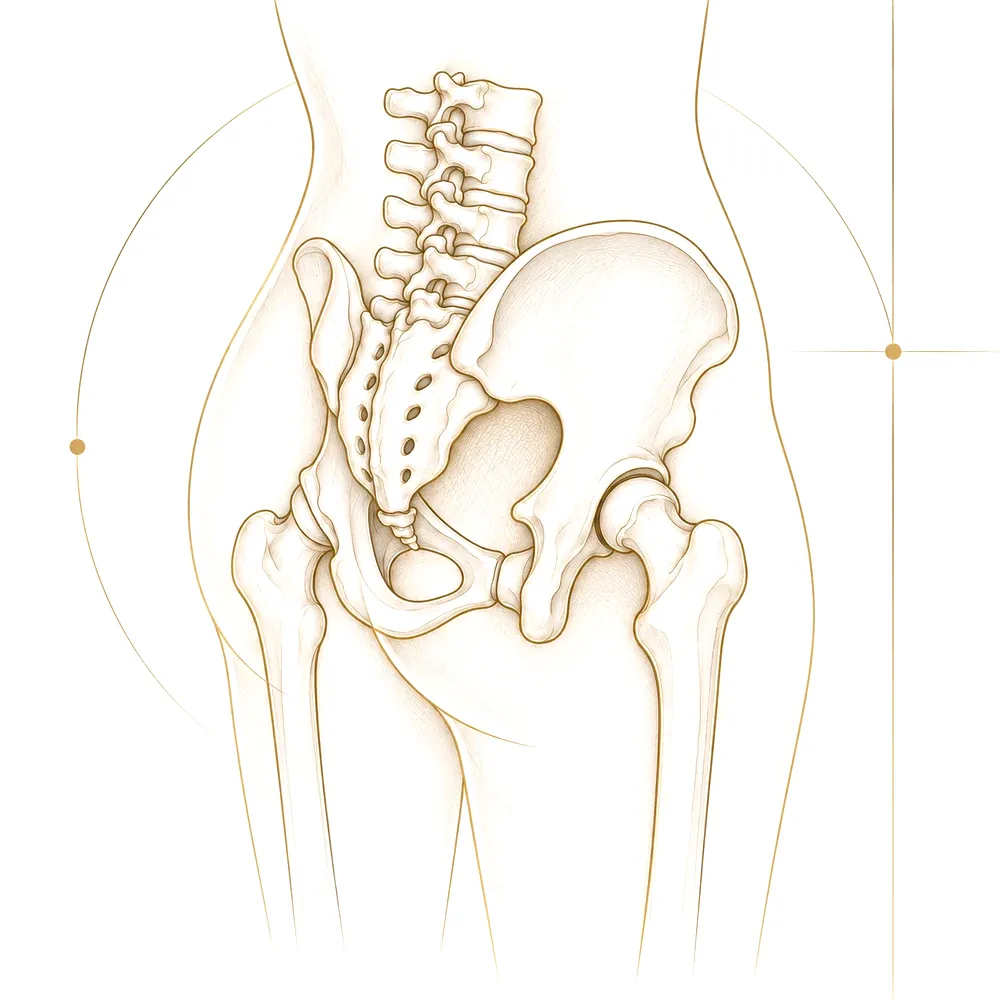
Because when you sit, especially leaning back, you put part of your weight on your coccyx: when it is irritated, it copes badly. The coccyx, or tailbone, is the small bone at the end of the spine, right at the top of the cleft between the buttocks. Sitting upright or leaning slightly forward, your two sitting bones carry most of your weight. As soon as you slump back, the coccyx takes on part of the load again.
When you get up, it moves. If it has become too mobile, or on the contrary too stiff, that is when the pain is sharpest.
This pain, coccydynia, affects far more women than men, probably because of the shape of their pelvis. It is usually felt right in the middle, at the very bottom of the back. Pain on one side only, in the buttock, or that travels down the leg tells a different story: our article Sciatica: it keeps coming back, and you don’t know why will help you tell the difference.
Why does my coccyx hurt when I haven’t fallen?
Without a fall, the coccyx can become irritated after childbirth, long hours sitting or a lot of cycling; in some people, no cause is found. During childbirth, it is pushed backwards as the baby passes. And a fall sometimes goes back so far that it has been forgotten. When the pain is there for no particular reason, it is puzzling; that uncertainty can become a source of stress. Your doctor first checks that it is not hiding anything else.
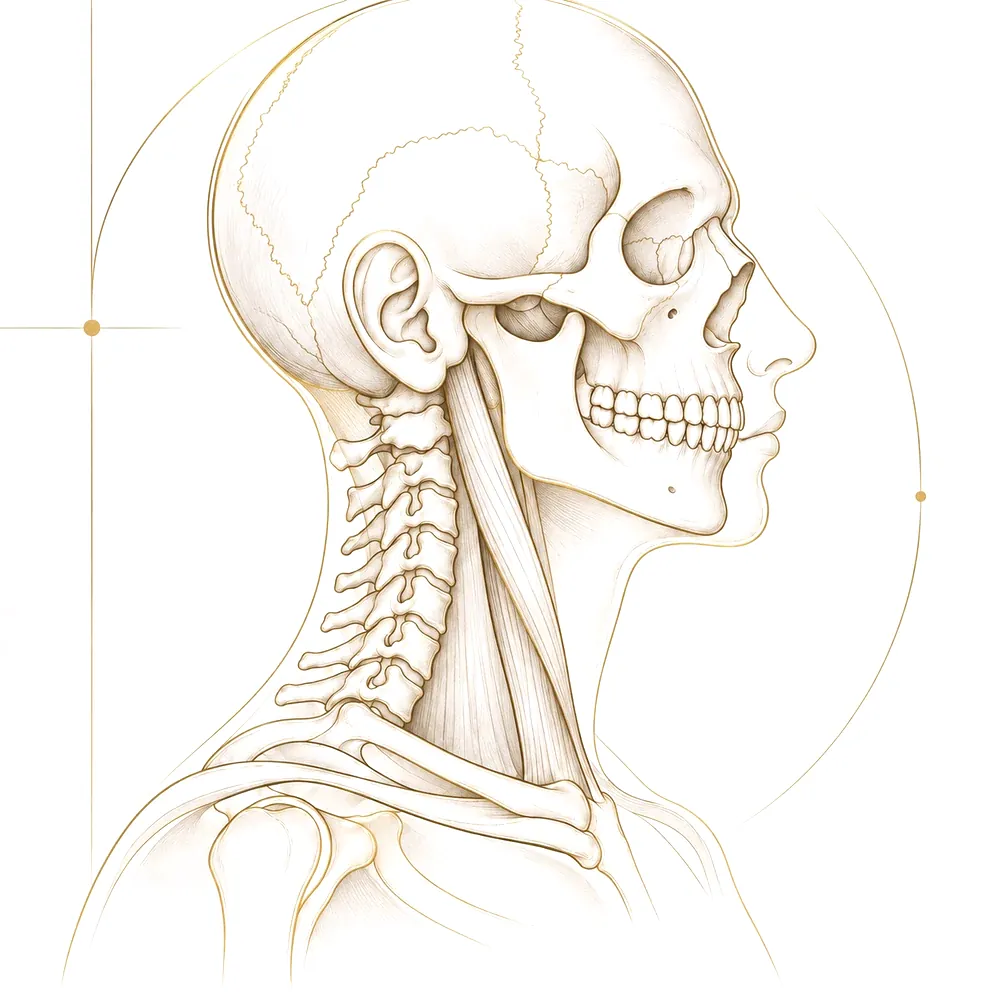
At the clinic, I also see that the pain can be kept going by what is happening higher up. The dura mater, the membrane that surrounds the brain and the spinal cord, runs down the spine to the sacrum; a thin cord continues it down to the coccyx. It is through this path, and through the fascia that connects the whole body, that we explain how tension set in at the top can be felt all the way down.
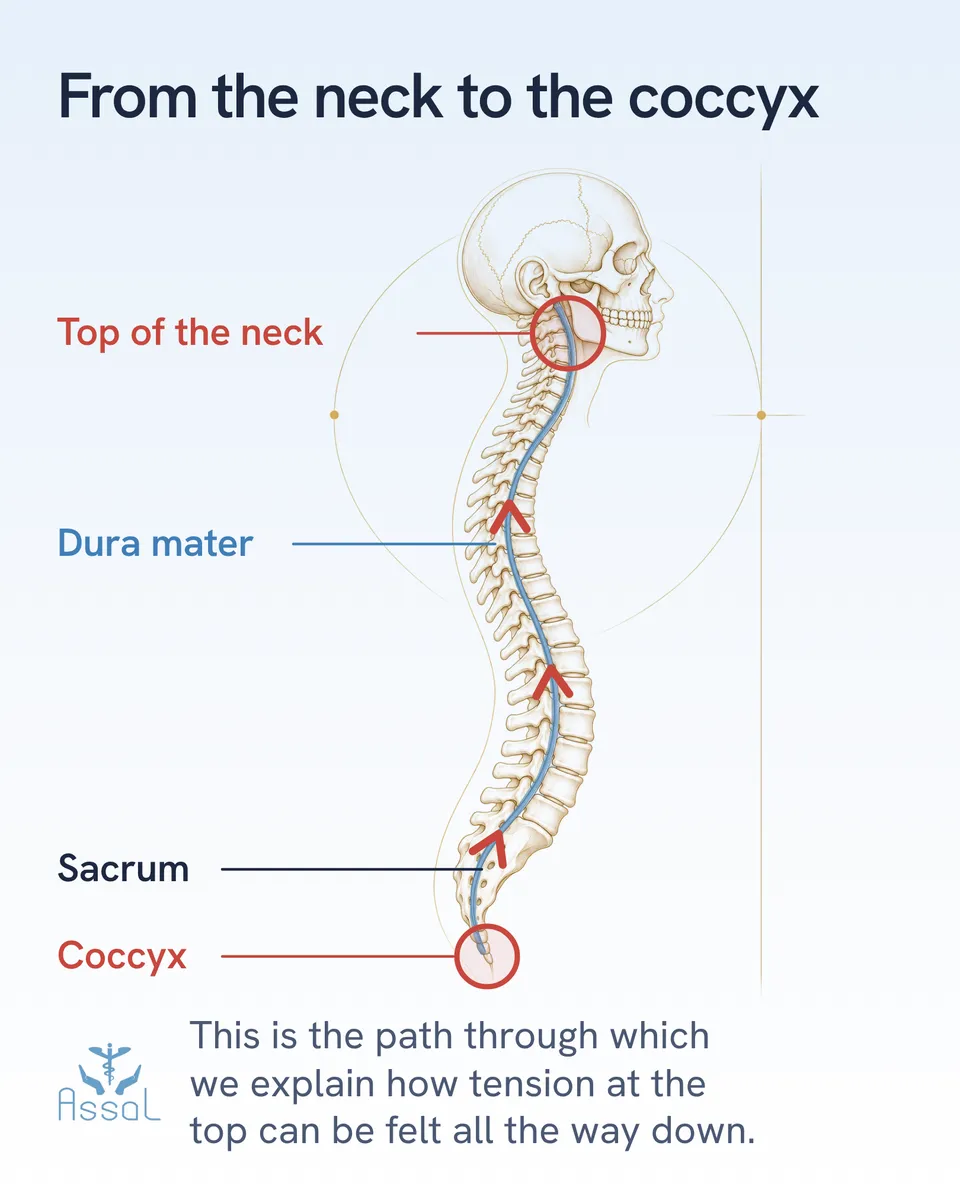
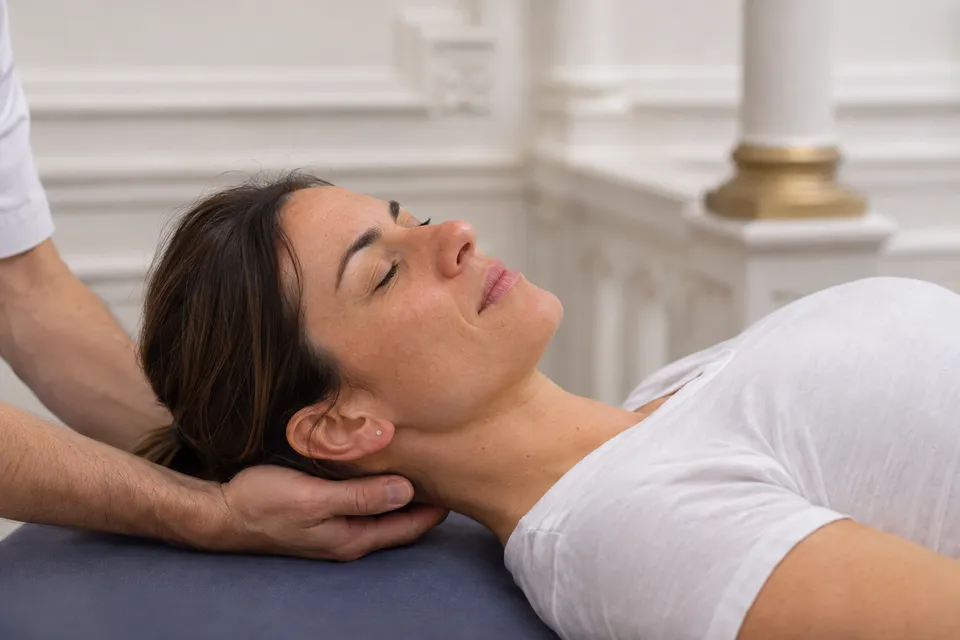
I am thinking of a patient in good health, with no history of a fall or of local trauma. He worked a lot, sitting a lot, at his desk. Every now and then, as he sat down, a very sharp pain gripped his coccyx. At the coccyx itself, the examinations showed nothing of note. I found the main tension right at the top of the neck, at the base of the skull. I worked there first, the neck and the skull, then went back to the lower back, the sacrum and the coccyx with tissue work. His pain went after that session.
The pain was at the bottom.
Part of the answer was at the top.
What can you do to relieve coccyx pain?
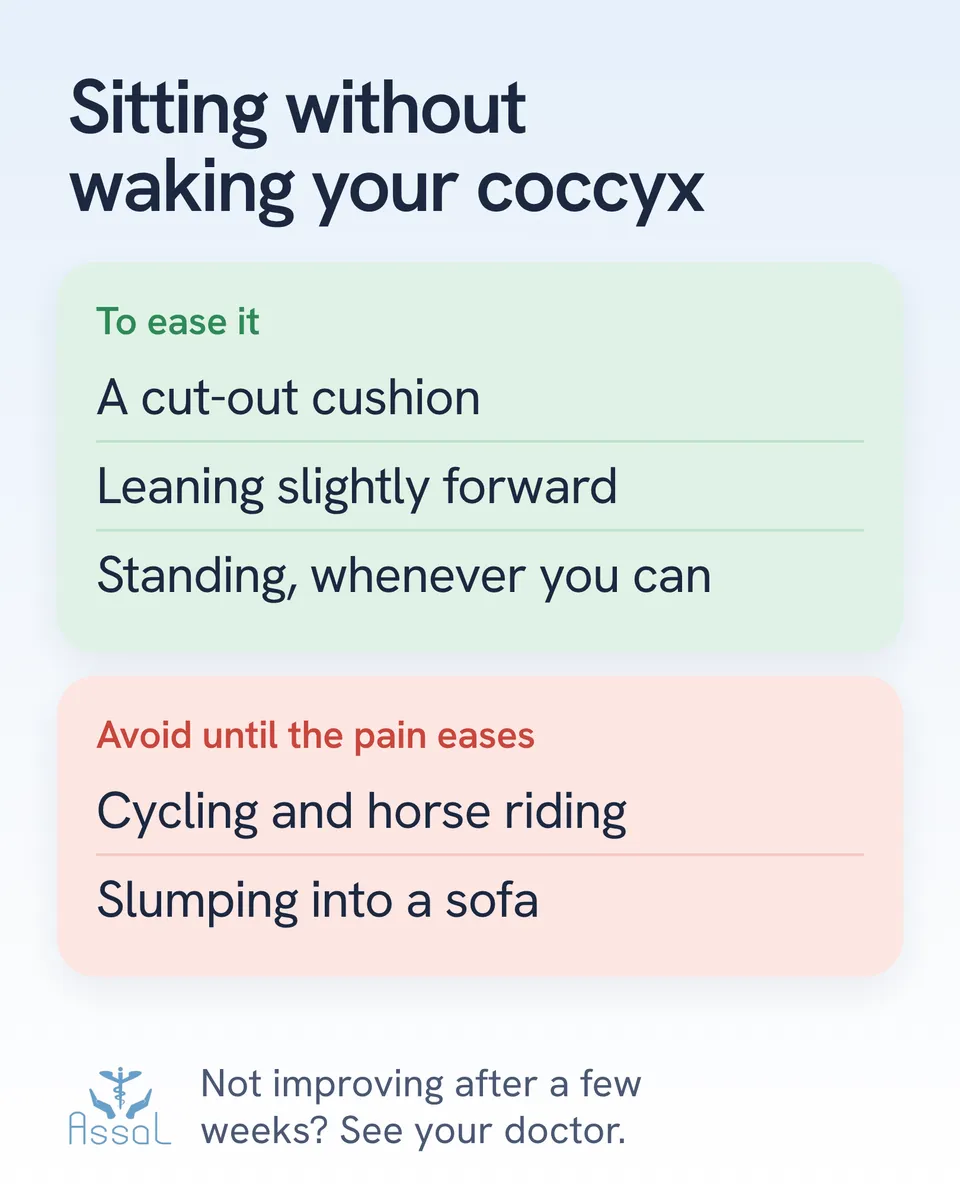
To relieve coccyx pain, first take off the pressure that weighs on it every time you sit down.
A cushion with a cut-out at the back. U-shaped or triangular, it leaves your coccyx free. A ring (doughnut) cushion helps less: its back edge can press on it. Take your cushion to work as well as in the car.
Sitting, leaning slightly forward. Your weight then moves onto your sitting bones. Avoid slumping deep into a sofa.
Standing, whenever you can. At work, get up often; work standing for a while if your workstation allows it.
At night, on your side. In this position, nothing presses on your coccyx any more.
Cold or heat. A cold pack or a hot-water bottle, always wrapped in a cloth: use whichever brings you relief.
Your bowels. If opening your bowels brings the pain back, don’t strain: your pharmacist can recommend a stool softener.
Cycling and horse riding. Set them aside until the pain eases.
Medication. For a painkiller, ask your pharmacist or your doctor for advice. Without a doctor’s advice, an anti-inflammatory such as ibuprofen should not be taken for more than five days. If you are pregnant, never take one without a doctor’s advice: from the sixth month of pregnancy, it is contraindicated, even a single dose, even as a gel or a cream.
How long does coccyx pain last?
Coccyx pain usually lasts a few weeks, sometimes several months: simple steps help it recede. After a hairline fracture, your doctor monitors how the bone heals.
Yet sometimes the pain persists long afterwards. A patient in her forties, sporty and in good health, had cracked her coccyx and sacrum in a skiing fall. The follow-up X-ray no longer showed any trace: on that side, there was nothing more to do. The pain, however, kept coming back, especially when she sat for a very long time or was exhausted. She had tried a ring cushion, but she could not use it all the time.
The X-ray said the bone had healed.
The pain said the story wasn’t over.
When should you worry about coccyx pain?
Rarely, except when a few signs mean you should see someone without waiting: coccyx pain most often comes from a knock or from repeated strain, very rarely from a serious illness.
These signs can’t wait
Go to the emergency department or call 15 if a leg loses strength, if the skin between your thighs, around the genitals or the anus becomes less sensitive, if you have difficulty passing urine, leaks, or if you can no longer control your bowels.
See your doctor without delay if a violent fall leaves very sharp pain, or if you notice a fever, a hot, painful lump or discharge near the coccyx, blood in your stools or pain when opening your bowels that does not go away.
Also book an appointment quickly with your doctor if the pain is constant, even lying down or at night, with no knock to explain it, if you are losing weight for no reason or feel unusually tired, if you have had cancer, or if it comes back with your periods.
Who should you see for coccyx pain?
Your doctor first, if the pain lasts more than a few weeks or if a warning sign applies to you: they rule out another cause and decide whether a test is useful.
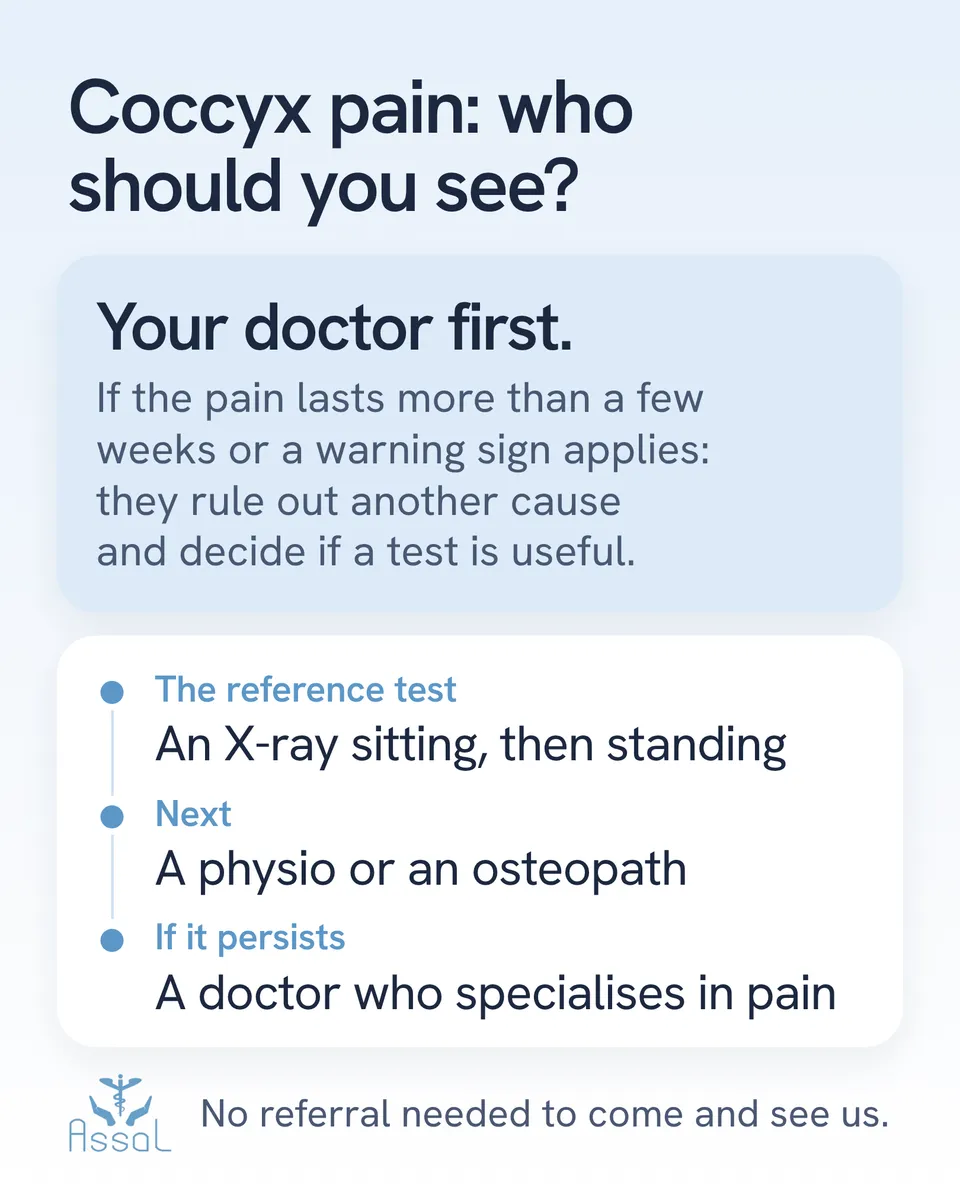
The reference test is an X-ray taken sitting and then standing, which shows how the coccyx moves. Several professionals can then help you. A physiotherapist works on the muscles around the coccyx and on the pelvic floor. An osteopath looks for where the pain is coming from, around the coccyx and higher up. You don’t need a referral to come and see us; our Lower back, pelvis and lower abdomen page explains our approach. If the pain persists, a doctor who specialises in pain can offer an injection. Surgery is rare, kept for pain that lasts for months despite everything else.
Can osteopathy relieve coccyx pain?
Yes, when tension around the coccyx or higher up in the body is keeping the pain going, provided no sign first calls for a doctor’s opinion. It has to be said: studies on manual treatments for the coccyx are few and involve small groups. Some report a reduction in pain, clearer when the pain is recent; some of them concern internal techniques, which we do not practise.
Let’s go back to the patient who fell skiing. Around her coccyx, the fall had left tensions, but I found that they did not stop there: they ran up the spine, all the way to the top of the neck. They pulled harder in periods of stress or exhaustion. And it was when she was exhausted that her coccyx flared up.
Her bone had healed; the tissues around it had not. I often see it after a hairline fracture or a fracture: they do not forget the impact and roll up on themselves, like a sheet of aluminium foil that has been crumpled and keeps its creases. At the clinic, we aim to unroll these tissues, so that they return to their relaxed shape and stop keeping tension going locally. Our work therefore has a twofold aim: to release around the coccyx and to treat at a distance.
I first treated the top of the neck, then the tensions around the coccyx, with tissue work and from the outside only, before finishing with the pelvis. I saw her twice: general work on the whole body the first time, then a check and precise work on the coccyx the second. Since then, nothing. It is not always as clear-cut: we will not promise you that.
Looking for what keeps the pain going before treating the place where it screams: that is the heart of the ASSAL Method and of the ASSAL test, which I developed.
The ASSAL Method
The ASSAL Method is the approach we apply in our clinics in Paris 8 and Vitry-sur-Seine, developed by Hosam ASSAL, osteopath. It relies on the ASSAL test. Of all the areas under tension, this test looks for the one that came first, and you see the result at the same time as we do.
Are you in Paris or the Val-de-Marne, and does every day spent sitting cost you at the coccyx? Before treating, we look for where it all began. Book an appointment in Paris 8 or Vitry-sur-Seine.
Is the treatment done internally?
Not with us: unless they are also a doctor or an authorised health professional, an osteopath is not allowed to use internal techniques. We work from the outside only. The decree that governs our profession limits our techniques to manipulations that are “exclusively manual and external” and prohibits internal pelvic examinations. Some doctors use internal techniques: if yours considers them useful, they will refer you.
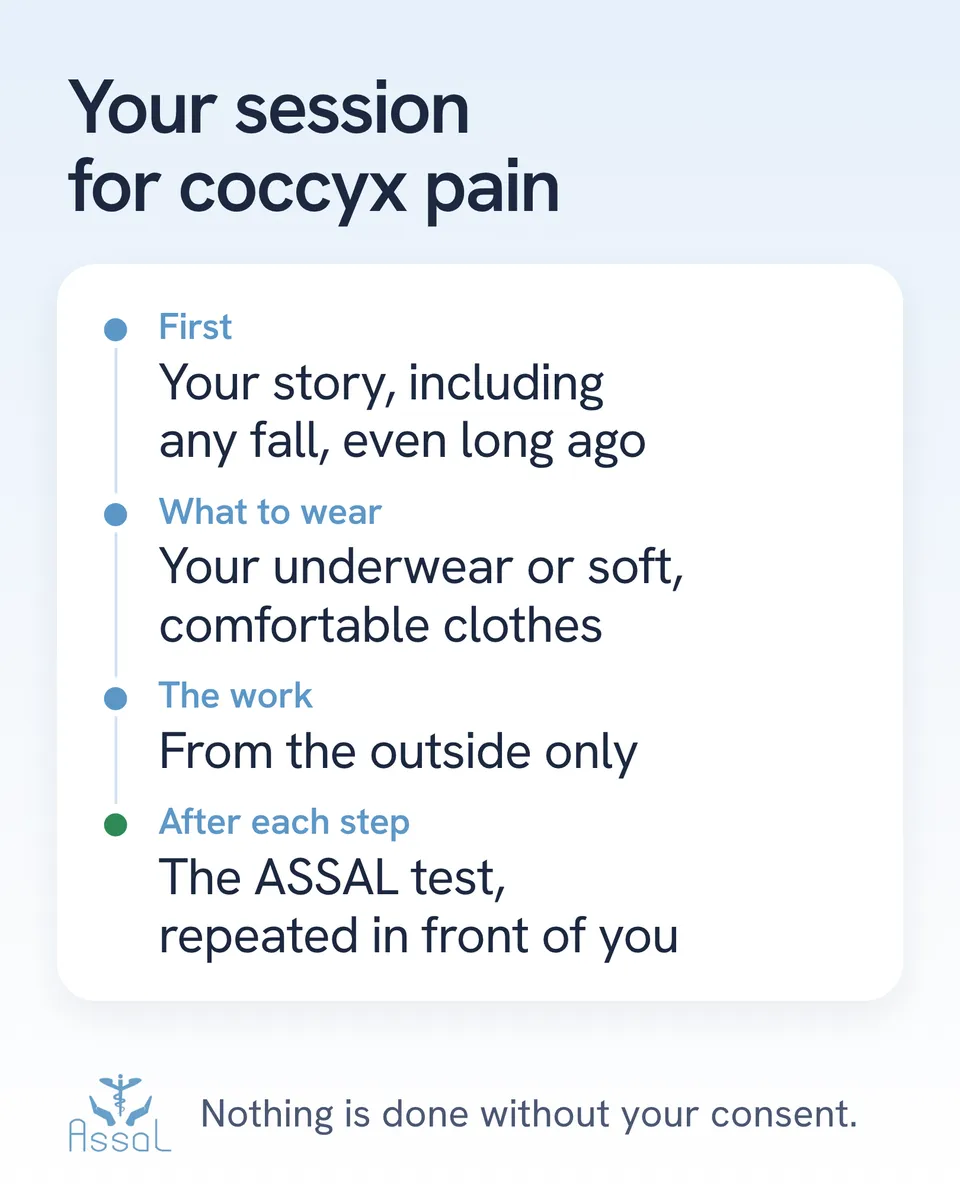
It all starts with your story, including any fall, even long ago. You keep your underwear on, or wear soft, comfortable clothes. A sheet covers you, except for the area we are working on. We work around the coccyx as well as at a distance: the pelvis, the back, the top of the neck. After each step, we repeat the test in front of you. Nothing is done without your consent. If talking about your coccyx makes you uncomfortable, just say so: for us, it is a part of the back like any other. Before each technique, we explain what we are going to do and why.
Coccyx pain after giving birth: what can you do?
Talk to your midwife or your doctor, at the postnatal check or before if the pain is severe: childbirth is one of the most common causes. The everyday steps are the same: a cushion with a cut-out, your upper body leaning slightly forward, breaks spent standing. If the pain sets in, we see new mothers as soon as they feel ready, most of them a few weeks after the birth. Our Pregnancy and postpartum page explains how we support them.
Should you come back once the pain has gone?
Yes: a second session is useful to check how your body’s adaptation is progressing and to act preventively. This is true even when the pain went after the first session, as it did for the patient who worked sitting down.
Between two sessions, notice your moments. For the patient who fell skiing, the pain came back with exhaustion. For the patient at his desk, at the moment he sat down. Write them down and tell us about them at the second session.

For your first appointment, you can book directly online, Monday to Sunday. Can’t find a slot that suits you? Send us a message on WhatsApp at +33 6 51 77 41 86: tell us in a sentence what is happening and when you are available, and we will look for a solution.
Sitting down is the most ordinary movement of the day. You repeat it without thinking, until the day every chair becomes a calculation.
Finding where the pain comes from: one patient put it in her own words.
“A very good listener, he really takes the time during each session, without ever rushing. He knows exactly how to locate where the pain comes from and works with great precision, a lot of gentleness and kindness.”
Charlotte, patient of Hosam ASSAL in Paris 8 (translated from French)
In Paris 8 as in Vitry-sur-Seine, we take the time to understand your pain, from your coccyx up to your neck, then we do what is needed to bring you a solution and help you sit down again without thinking about it. Book online, Monday to Sunday:
In Paris 8, with me or with Michaël.
In Vitry-sur-Seine, with me or with Amine.
Prefer to call? +33 1 44 09 95 80 for Paris 8, +33 1 75 37 53 41 for Vitry-sur-Seine.
Sitting down should never be a calculation.
Let’s find out together what made it difficult.
About the author
Hosam ASSAL is an osteopath (French Diploma in Osteopathy, D.O.), trained at the École Supérieure d’Ostéopathie de Paris, and has been in practice for more than ten years. Founder of the ASSAL Method, he sees patients in Paris 8 and Vitry-sur-Seine, alongside Michaël Vallée Kallézis and Amine Medjaoui. He also teaches his method to osteopaths and to final-year osteopathy students.
Find the origin of your pain
A consultation helps you understand where your pain really comes from, and how to address it, taking your history into account.