
Fascia, the little-known tissue that connects the whole body
You may already have heard of it, often in a rather vague context. Yet fascia has been the subject of serious research for some twenty years, and what has been discovered changes the way certain kinds of pain are understood. Here is what is established, and what is still unproven.
You have already seen it, without realising
If you have ever prepared a piece of meat, you know what fascia is. It is the thin, white, pearly film that covers the muscle, the one you trim off with a knife before cooking. In your body it is identical, and it is everywhere.
Fascia is a connective tissue. It wraps each muscle, then each group of muscles. It surrounds the bones, the joints, the nerves, the blood vessels and every one of your organs. It goes as far as separating the fibres within a single muscle.
The most accurate image is a full-body wetsuit that would cover you from head to toe, but would also reach inside, wrapping every part of the body individually. This tissue forms a continuous, three-dimensional network from the top of the skull to the soles of the feet.
Its make-up explains how it behaves. It contains collagen, which gives it strength, elastin, which gives it flexibility, and a very well-hydrated matrix that lets it glide over itself. Healthy fascia glides. It is this ability to glide that makes your movements smooth and economical.
The discovery that changed everything
For a long time, anatomists regarded fascia as packaging. In dissection, it was removed to get to what was considered interesting: the muscle, the bone, the nerve. It was the wrapping paper, never the present.
Research over the past twenty years or so has overturned this view, and the turning point comes down to a single observation.
The muscle’s wrapping is more sensitive to pain than the muscle itself.
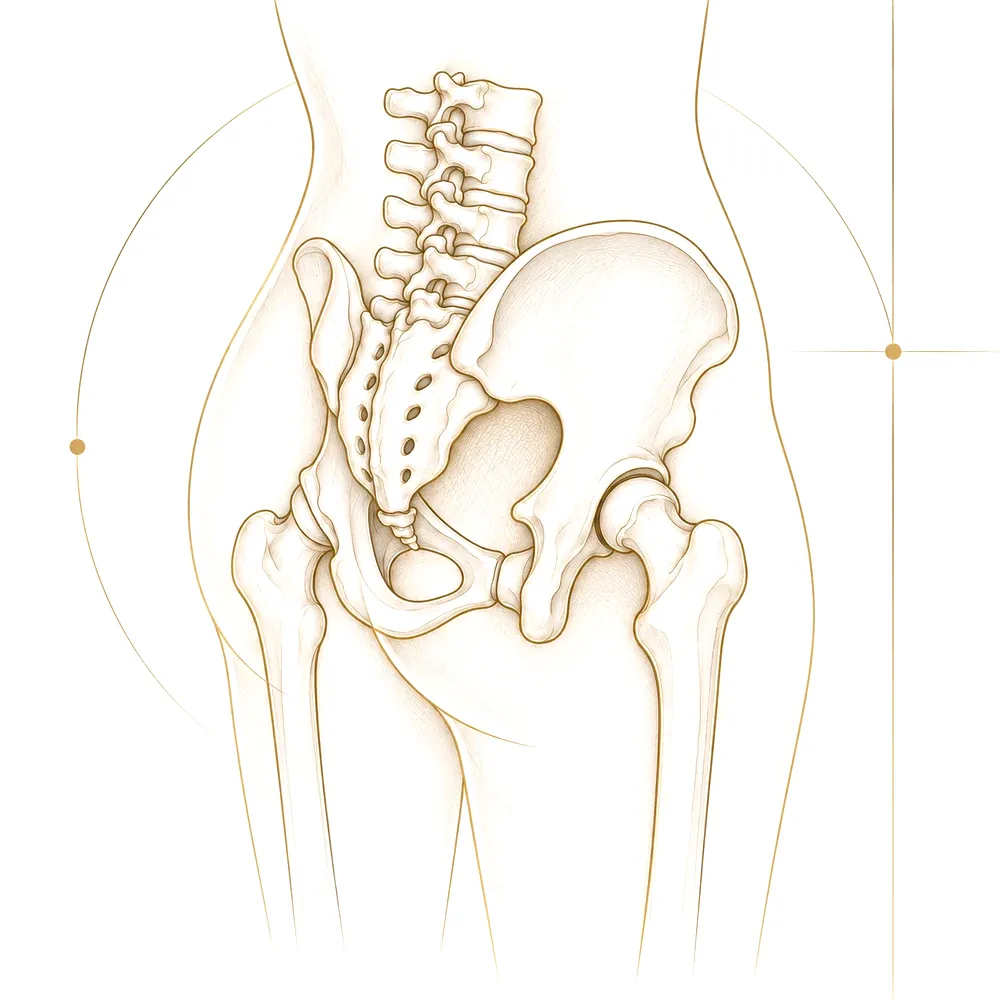
Studies of the fascia in the lower back, known as the thoracolumbar fascia, show dense innervation and a greater sensitivity to pain than the muscles it covers. And these nerve fibres are not just cables passing through. There are three kinds.
Proprioceptive fibres, which constantly inform your brain of the position and movement of every part of your body. Nociceptive fibres, which signal excessive strain, in other words fibres that can produce pain. And fibres of the autonomic nervous system, which regulates your circulation, your digestion and your level of alertness without any conscious control on your part.
In other words, this tissue that used to be thrown in the dissection-room bin is one of the richest sensory organs in your body.
Why this matters when you are in pain
This discovery has a direct, practical consequence.
If fascia contains pain receptors, then fascia can hurt in its own right, without any muscle, disc or joint being involved.
It is one of the most studied avenues today for explaining what is known as non-specific low back pain, where imaging shows nothing that matches what the patient feels. Researchers have shown that when fascia is inflamed, its innervation changes, and it then becomes a source of pain in its own right.
When tissue glides badly, it hurts.
When fascia loses its ability to glide, because of prolonged immobility, inflammation, a scar or tension held for too long, it thickens and becomes denser locally. The layers that should slide over one another start to catch. The receptors it contains are then constantly stimulated, and the message they send ends up being interpreted as pain.
This explains something many patients describe without finding the words: a diffuse, poorly localised pain that you cannot put your finger on, and that does not follow any known nerve pathway.
The thread that links one pain to another
The second contribution of this research concerns continuity.
Because fascia forms an unbroken network, tension applied in one place is passed on elsewhere. Pierre Tricot offers an image that we often use in consultations, because people grasp it straight away. Take a woollen jumper and pull on a stitch in the sleeve. You will see the neck of the jumper pull out of shape.
Your body works the same way. An area that pulls shifts the strain along the network, and sometimes it is at the other end that the tissue finally cries out.
Experimental studies have measured this phenomenon. Simply working on the fascia of the sole of the foot immediately improves flexibility in the back of the thigh and the lower back, in people who received no treatment in those areas. A systematic review of the literature has confirmed that several of these long-distance links exist at a functional level.
This gives an anatomical basis to something every manual therapy practitioner observes daily: the area that hurts is not always the area that is causing the problem.
The link with stress
There is one last point, and it follows from the autonomic nerve fibres found in fascia.
This tissue reacts to your inner state. When you are under pressure for a long time, background muscle tone rises, breathing becomes shorter and some areas of fascia lose their flexibility. The diaphragm area and the lower back are particularly affected.
This mechanism explains why a difficult period can result in very real, very mechanical pain several months later. The body does not make anything up. It translates.
What is established, and what is not
The word fascia has become fashionable, and today it is used to justify almost anything. We prefer to be precise about what the science actually supports.
What is solidly documented. The anatomical continuity of the network, which can be verified in dissection. The rich innervation of fascia and its ability to generate pain. The role of the thoracolumbar fascia in transmitting forces between the trunk and the legs. And the existence of several functional long-distance links, measured experimentally.
What is a useful model rather than a certainty. The maps that draw lines of tension running through the entire body are practical representations, validated for some pathways and still debated for others. They help with reasoning, but they do not describe a reality as fixed as a diagram suggests.
What is a metaphor. You will often read claims that fascia stores the memory of trauma. The image is a vivid one, and it corresponds to something practitioners observe. But no memory mechanism in the strict sense has been demonstrated in this tissue. What can be observed are lasting changes in its flexibility and in how it glides, which is not the same thing.
Distinguishing what has been demonstrated from what is probable is part of the job. Patients have the right to know what the care they are offered is based on.
What this changes in our consultations
In practice, this understanding leads us to do two things.
The first is to test far from the symptom. When pain resists local treatment, we systematically check whether a distant area, often a silent one, is keeping the strain going. An old scar, a foot that does not take weight properly, a diaphragm held rigid by a stressful period.
The second is to work gently. There is nothing spectacular about fascial techniques. They consist of sustained pressure and slowly applied tension, a far cry from the image of a joint being cracked. The tissue responds to time and precision more than to force.
And in every case, this understanding never replaces the standard examination. Fascia can hurt, but so can a fracture, an infection or nerve compression, and far more seriously. Looking for the distant link always comes after ruling out whatever needs to be ruled out.
In short
Fascia is neither a mystical discovery nor a sales pitch. It is very real tissue, richly innervated, continuous from one end of the body to the other, and we have only recently come to understand that it plays a direct part in pain and in the way you perceive your own body.
This knowledge does not replace classical anatomy. It fills in a part that was missing, and it explains what many patients feel without being able to describe it.
Find the origin of your pain
A consultation helps you understand where your pain really comes from, and how to address it, taking your history into account.